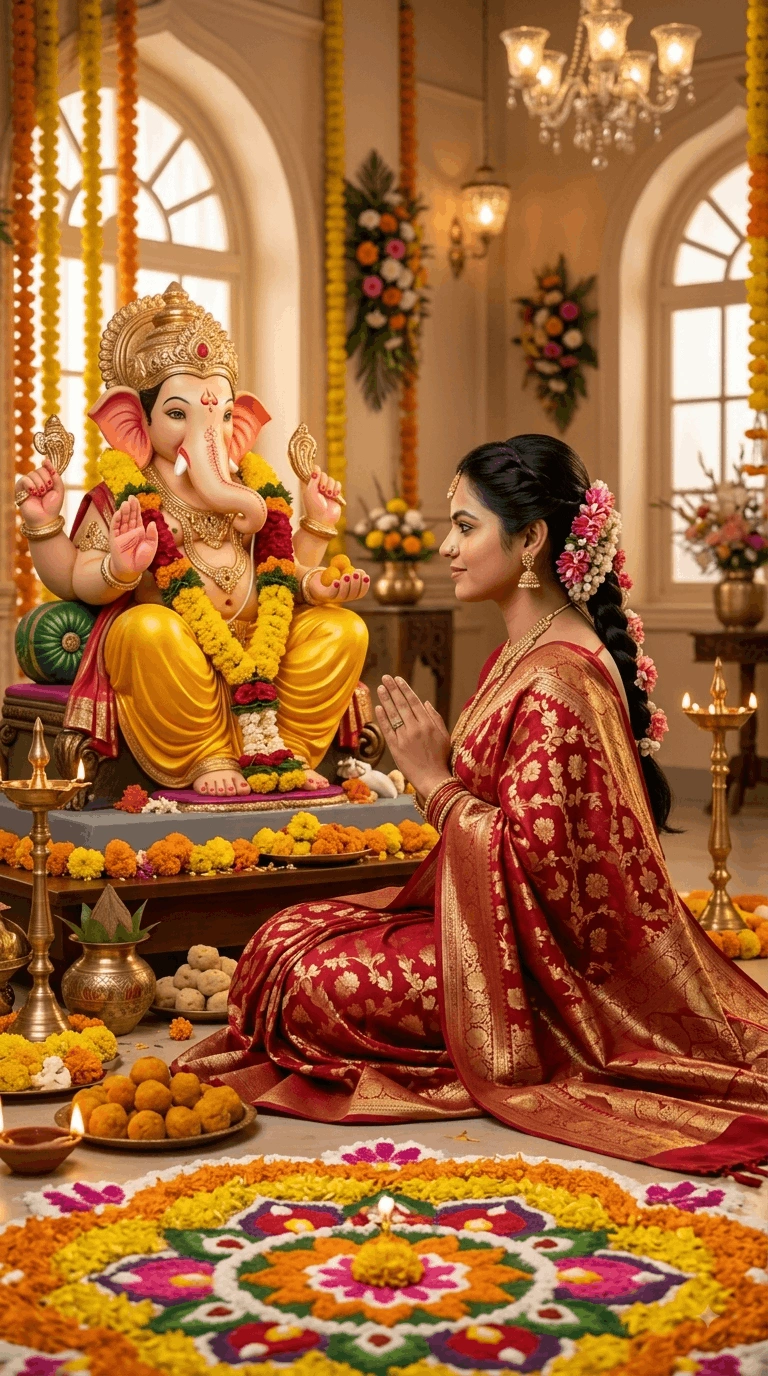
Devotional Ganesha Puja Portrait in Red Banarasi Silk Saree
Create a cinematic devotional Indian portrait of a woman sitting cross-legged be...
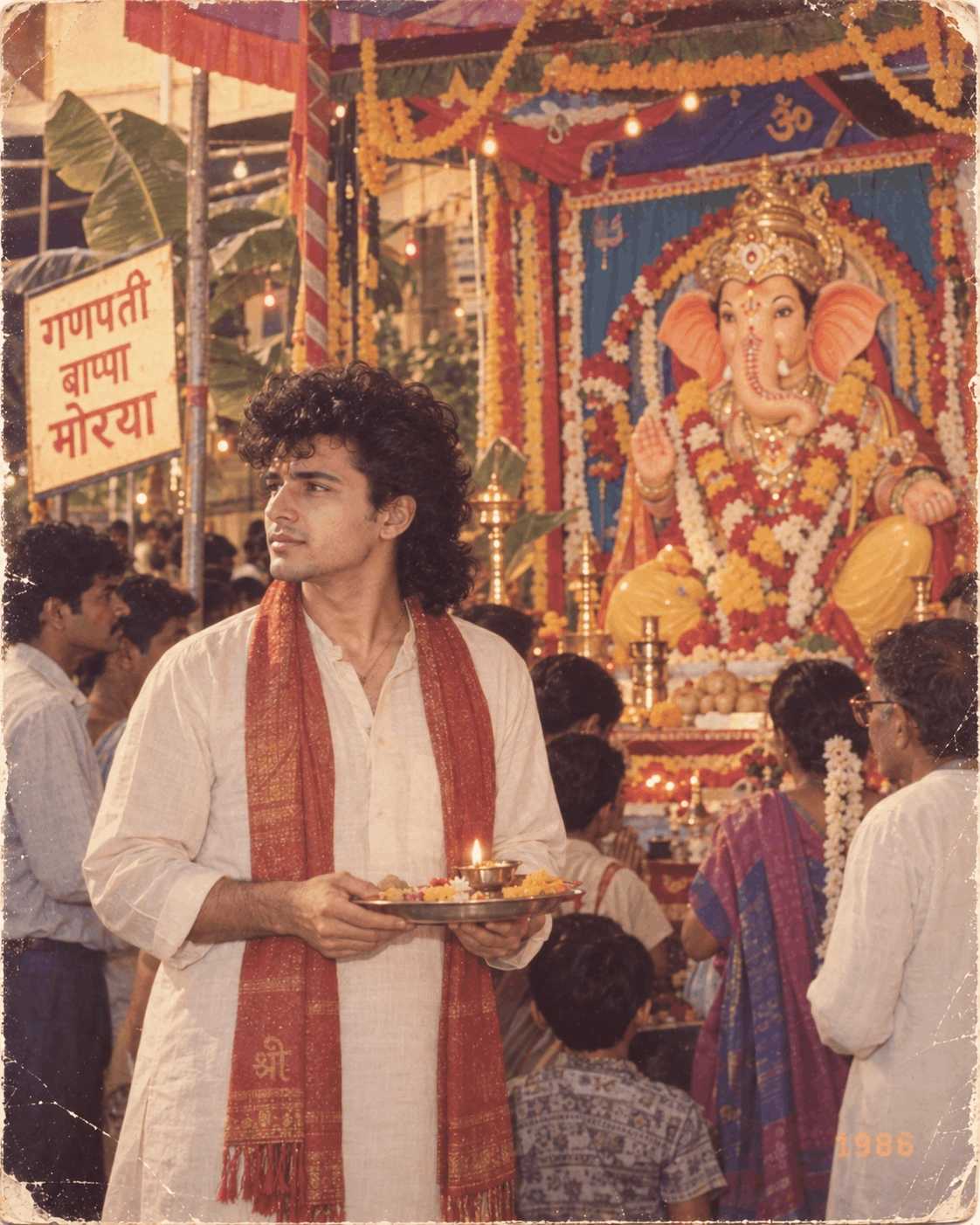
Transform a reference photo into an authentic 1980s Ganesh Chaturthi photograph in India, preserving facial identity while recreating a lively neighborhood pandal, traditional Ganesh idol, period clothing, incandescent festival lights, and genuine 35mm film character.
Using the uploaded reference photograph as the primary and strict facial identity reference, transform the recognizable person into a completely authentic mid-to-late 1980s Ganesh Chaturthi festival photograph in India.

IDENTITY PRESERVATION — HIGHEST PRIORITY:

Preserve the recognizable facial identity of the person with very high accuracy. Maintain the person's natural facial structure and proportions, including eye shape and spacing, eyebrows, nose, lips, mouth structure, jawline, chin, cheek structure, forehead proportions, ears, head shape, natural asymmetry, recognizable age, and distinctive physical characteristics.

The result must clearly resemble the same real person photographed in the 1980s rather than another person merely inspired by the reference.

Do not beautify, modernize, reshape, smooth, idealize, or artificially symmetrize the face. Preserve realistic skin texture and natural facial characteristics.

Use the uploaded photograph for facial identity only. Completely replace the original photograph's clothing, hairstyle, pose, framing, lighting, environment, and background.

HISTORICAL PERIOD:

Recreate the scene as a genuine Ganesh Chaturthi celebration in India around 1985–1988.

The entire photograph should appear as though it was captured during that period using an inexpensive consumer 35mm color film camera.

Avoid anything that visually belongs to contemporary India.

Create a lively neighborhood celebration containing a decorated Ganesh pandal, devotees, families, children, traditional festival decorations, temporary structures, and authentic period surroundings.

GANESH PANDAL:

Make a beautifully handcrafted Lord Ganesha idol the visual centerpiece of the festival.

The idol should have the appearance of a real community Ganesh Chaturthi idol from the 1980s rather than a gigantic modern event installation.

Include:
- traditionally sculpted Ganesha form
- hand-painted appearance
- expressive but natural face
- ornate traditional crown
- traditional jewelry
- red, saffron, yellow, orange, and gold decorative elements
- fresh marigold garlands
- additional natural flowers
- modak offerings
- traditional cloth backdrop
- brass devotional objects
- oil lamps
- simple incandescent festival lighting

Keep the idol realistically sized for a neighborhood community pandal.

FESTIVAL DECORATION:

Surround the pandal with authentic period decorations such as marigold garlands, banana leaves, traditional torans, colorful cloth canopies, handmade paper decorations, wooden poles, simple electrical decorations, strings of incandescent bulbs, and other modest community-made festival elements.

Avoid professionally designed modern event styling.

The pandal should look handmade, slightly imperfect, lived-in, and genuinely assembled by a local community.

SUBJECT CLOTHING:

Completely replace the person's original clothing with authentic Indian festive clothing appropriate to the 1980s.

If the recognizable person is female:
- period-appropriate Indian saree
- traditional blouse
- authentic 1980s fabric and draping
- simple gold jewelry
- traditional bangles
- small earrings
- optional bindi
- naturally styled 1980s hair

If the recognizable person is male:
- authentic 1980s kurta or traditional festival clothing
- period-appropriate fabric
- appropriate colors
- simple traditional accessories
- natural 1980s hairstyle

Do not use contemporary Indian fashion.

The clothing should appear naturally worn by a real festival attendee rather than styled for a modern fashion editorial.

POSE & BODY LANGUAGE:

Create a natural candid festival moment.

The subject may be:
- standing near the Ganesh pandal
- looking toward the Ganesha idol
- participating in aarti
- holding a small traditional puja plate
- standing among family and devotees
- naturally smiling toward the camera
- captured during a spontaneous moment in the celebration

Keep the pose relaxed, believable, and documentary-like.

Avoid stiff studio posing, fashion-editorial posing, or artificially perfect body positioning.

FACIAL EXPRESSION & GAZE:

Give the subject a natural expression appropriate to the specific festival moment.

If the subject is interacting with the Ganesh idol, allow their gaze to naturally follow the devotional activity. If the moment is a family snapshot, a gentle natural smile toward the camera is appropriate.

Do not force the same facial expression across different generations of this prompt. Preserve the expression that best supports the specific action and festival context.

Avoid exaggerated smiles, artificial serenity, or generic model expressions.

BACKGROUND & CROWD:

Create a believable Indian neighborhood crowd surrounding the celebration.

Include a natural mixture of:
- elderly devotees
- parents
- children
- teenagers
- neighborhood residents
- women in traditional sarees
- men in period-appropriate shirts
- men wearing kurtas
- families gathered near the pandal

The background should feel spontaneous and slightly crowded.

People should interact naturally with the festival rather than appearing individually posed.

All background clothing should visually belong to approximately 1985–1988.

PERIOD AUTHENTICITY:

Ensure background details are visually consistent with India during the mid-to-late 1980s.

Avoid:
- smartphones
- LED screens
- modern wearable technology
- modern advertising
- contemporary event furniture
- modern stage equipment
- modern photography equipment
- contemporary vehicles where avoidable
- modern architecture where avoidable
- contemporary typography
- modern commercial branding

Any visible vehicles, signs, consumer objects, architecture, electrical equipment, or household objects should be appropriate to approximately 1985–1988 India.

LIGHTING:

Recreate authentic festival lighting from the period.

Combine warm incandescent bulbs, small decorative festival lights, available evening ambient light, warm oil-lamp illumination, and occasional harsh direct camera flash.

Allow uneven exposure and natural shadows.

Some portions of the background may fall into darkness, especially in an evening celebration.

The lighting should feel imperfect and documentary-like, consistent with an inexpensive 1980s consumer camera.

CAMERA:

Simulate an ordinary consumer 35mm color film camera from the 1980s.

Use realistic period optical characteristics:
- moderate lens sharpness
- gentle softness
- natural perspective
- subtle depth of field
- minor focus imperfections
- imperfect exposure
- fine film grain
- authentic analog color response
- subtle halation around bright bulbs
- realistic photographic contrast

Do not create the clinical sharpness of a modern full-frame digital camera.

FILM CHARACTER:

The photograph should feel genuinely exposed onto 1980s consumer color film.

Use:
- subtle fine grain
- slightly warm color response
- mild color fading
- gentle contrast
- softened highlights
- natural shadow behavior
- slight optical softness
- restrained halation
- minor exposure variation
- authentic film texture

Do not use exaggerated sepia, artificial scratches covering the entire photograph, heavy digital noise, or an obvious Instagram-style vintage preset.

COLOR PALETTE:

Use an authentic Indian festival palette consisting of:
- saffron
- vermilion red
- marigold orange
- yellow
- muted green
- cream
- traditional gold
- warm brown
- naturally faded festival colors

Keep colors lively enough to communicate Ganesh Chaturthi while maintaining the slightly imperfect color response of aged 1980s film.

COMPOSITION:

Create a documentary-style family photograph.

The recognizable person should remain the primary human subject while the Ganesh idol and decorated pandal clearly establish the festival.

Position the subject naturally in the foreground or middle ground, with the Ganesha idol visible behind or beside them.

Use realistic photographic depth and spatial relationships.

Do not make the subject appear cut out or digitally pasted into the background.

Ensure consistent:
- perspective
- lighting
- shadows
- skin texture
- depth of field
- film grain
- color response

The same camera should appear to have photographed the subject and environment at the same moment.

HISTORICAL PHOTOGRAPHIC AUTHENTICITY:

The final image should make the viewer believe:

"This is an actual photograph of this person attending Ganesh Chaturthi in India around 1986."

The image should not resemble:
- an AI fantasy
- a modern portrait with a vintage filter
- a Bollywood poster
- a commercial festival advertisement
- a professional studio photograph
- a modern fashion shoot
- a contemporary wedding photograph
- a digitally composited person placed over an old background

Everything should feel naturally photographed at the same moment.

REALISM:

Maintain:
- recognizable facial identity
- natural skin texture
- realistic hair
- accurate hands
- natural body proportions
- realistic clothing folds
- believable crowd interactions
- physically coherent objects
- accurate perspective
- consistent lighting
- realistic shadows
- authentic film rendering

Keep sufficient facial detail for strong identity recognition while retaining the softer rendering expected from period film photography.

IDENTITY PRIORITY:

The uploaded reference controls facial identity only.

Do not allow the original image's hairstyle, clothing, pose, framing, environment, or background to leak into the new composition.

The person's identity should remain recognizable through facial structure and defining features while everything surrounding the face is authentically transformed into the 1980s festival scene.

NEGATIVE REQUIREMENTS:

Do not change the person's identity.

Do not generate a different face.

Do not merge facial features with background people.

Do not significantly alter the person's recognizable age or physical characteristics.

Do not beautify or modernize the face.

Do not apply contemporary skin smoothing.

Do not introduce artificial facial symmetry.

Do not use contemporary Indian clothing.

Do not use modern festival decorations.

Do not use smartphones, LED screens, modern signage, modern cars, modern advertising, or contemporary technology.

Do not create an oversized futuristic Ganesh installation.

Do not turn the scene into a Bollywood poster.

Do not create a commercial event advertisement.

Do not use modern cinematic lighting.

Do not use HDR.

Do not over-sharpen.

Do not create plastic-looking skin.

Do not use excessive digital grain.

Do not use extreme sepia.

Do not add exaggerated film scratches.

Do not create an obviously artificial AI face.

Do not make the photograph perfectly clean or digitally flawless.

FINAL RESULT:

Create a believable, candid, historically authentic 1980s Indian Ganesh Chaturthi photograph featuring the same recognizable person from the uploaded reference.

The person should appear naturally dressed in period-appropriate Indian festive clothing and integrated into a lively neighborhood Ganesh celebration surrounded by a handcrafted Ganesha idol, marigold garlands, banana leaves, colorful cloth decorations, incandescent bulbs, devotees, children, and families.

The entire image should have the visual characteristics of an inexpensive 1980s consumer 35mm photograph: warm analog colors, gentle contrast, subtle film grain, slight softness, mild halation, imperfect exposure, natural photographic depth, and restrained aging.

The final result must feel like a genuine family or neighborhood photograph from approximately 1986—not a modern image given a retro filter.
Learn how to use this prompt effectively and maximize the quality of your AI-generated output.
Recreate a recognizable person as though they were genuinely photographed attending Ganesh Chaturthi in India during the mid-to-late 1980s. The uploaded reference photograph is used strictly for facial identity, allowing the person's original clothing, hairstyle, pose, framing, lighting, and background to be completely replaced with a historically appropriate festival scene.
The scene captures the atmosphere of an authentic neighborhood Ganesh Chaturthi celebration around 1985–1988, featuring a beautifully handcrafted Ganesh idol, marigold garlands, banana leaves, cloth canopies, handmade decorations, incandescent bulbs, devotees, children, families, and traditional Indian clothing. The subject is naturally integrated into the crowded festival environment rather than appearing like a modern portrait composited onto an old background.
The uploaded photograph is used primarily for recognizable facial identity while the surrounding visual story is completely recreated.
A traditional community pandal features a handcrafted Ganesha idol, flowers, cloth decorations, brass devotional objects, and simple period lighting.
The neighborhood, clothing, decorations, objects, and crowd are designed to feel consistent with Indian life around 1985–1988.
Fine grain, gentle softness, warm analog colors, subtle halation, and imperfect exposure recreate an inexpensive 1980s film camera.
Warm incandescent bulbs, oil lamps, ambient evening light, and occasional direct flash create believable period illumination.
Families, children, elderly devotees, teenagers, and neighborhood residents create the spontaneous feeling of a genuine community celebration.
This prompt is ideal for people who want to place themselves or someone they know into a historically styled Ganesh Chaturthi memory. It is especially useful for nostalgic family-photo recreations, cultural storytelling, festival content, Indian heritage projects, and vintage photography concepts.
Why You'll Love It
Rather than applying a generic vintage filter, this prompt reconstructs the complete photographic environment of an Indian Ganesh Chaturthi celebration from the 1980s, combining strict facial identity preservation with period clothing, traditional decorations, community atmosphere, consumer-film characteristics, and authentic analog imperfections.
Upload a clear reference photograph of the person whose facial identity you want to preserve. The reference controls the person's recognizable face, while the prompt rebuilds the hairstyle, clothing, pose, environment, festival, and photographic era as an authentic 1980s Ganesh Chaturthi memory.
The strongest results come from treating the scene as a real historical photograph rather than a modern portrait with an old-film overlay. Period clothing, handmade decorations, crowd behavior, lighting, camera imperfections, film color response, and environmental details should all belong to the same 1985–1988 moment.
Explore more ganesh chaturthi prompts similar to this one.
Create a cinematic devotional Indian portrait of a woman sitting cross-legged be...
Create an ultra-realistic Ganesh Chaturthi baby portrait featuring a smiling Ind...
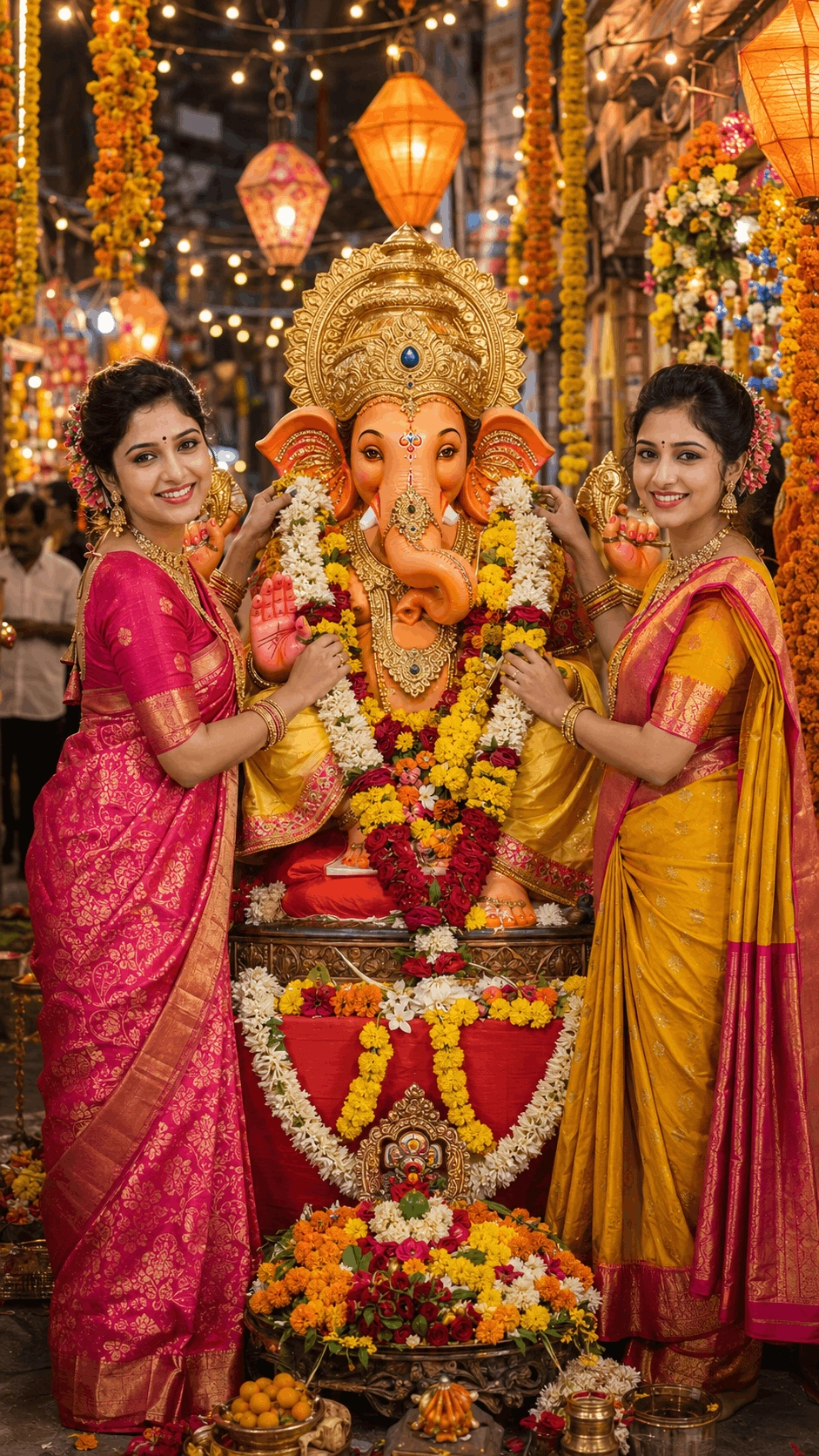
Create a photorealistic Ganesh Chaturthi portrait featuring two women with disti...
Create an amazing result using this prompt and share it with the Prompt Locator community. Selected submissions may be featured in this gallery to inspire other creators.
Help us keep Prompt Locator safe by reporting inappropriate content.
Help improve this prompt by submitting your suggestion.